Sadly, it seems we must delay racing our MTcars till after the holidays. I tried out a couple of them at the tennis court this afternoon, and it seems not to be as good as I had hoped it would be. Slightly sloped (so rain doesn't puddle) and too much friction, I guess. So we will wait. In the meantime, you may take yours home and fiddle, if you like, so long as you bring it back whole. I think all the cars would benefit from increasing the traction, using balloons or gluing rubber bands around the wheels. Reducing friction also, and aligning the wheels, shortening the string so it doesn't tangle or get caught on the hub may also need to be done.
Homework is the worksheet that was so difficult to print from last blog, but this time it needs to be completed, with the exception of where it asks for you to calculate speed, acceleration and momentum. (Answer the questions where it says "Application," and also the page of the 3 laws.) The worksheet does not leave sufficient room to answer the questions, so use a separate piece of paper, and write your answers in complete sentences. Type, if you can.
Also, if you did not complete the test, you need to do so as a worksheet and turn it in.
Thanks!
Monday, December 16, 2013

Friday, December 13, 2013
A little more Science...
Lastly, read again the handout about the science of mousetrap cars. Print out this worksheet: mousetrap car assessment and write in the definitions only, for now.
Understand these things: force, speed, friction, mass, acceleration, momentum, gravity, weight, and also how Newton's 3 laws apply to your mousetrap car.
Lastly, read again the handout about the science of mousetrap cars. Print out this worksheet: mousetrap car assessment and write in the definitions only, for now.
Understand these things: force, speed, friction, mass, acceleration, momentum, gravity, weight, and also how Newton's 3 laws apply to your mousetrap car.
Tuesday, December 10, 2013
It's a Test!
Homework due on Thursday is the Chapter 3 test, handed out in class. Here are the directions:
1. Review vocabulary, summary, and worksheets.
2. Take the test without books or notes. Use a pencil or regular blue/black inkpen.
3. Anything you couldn't answer on your own, find the answer in the textbook --USE COLORED INK, like red or green or purple, and do NOT erase your original answer. You will receive half-credit for this.
NO LATE WORK ACCEPTED.
And here are a couple interesting science videos:
1. Review vocabulary, summary, and worksheets.
2. Take the test without books or notes. Use a pencil or regular blue/black inkpen.
3. Anything you couldn't answer on your own, find the answer in the textbook --USE COLORED INK, like red or green or purple, and do NOT erase your original answer. You will receive half-credit for this.
NO LATE WORK ACCEPTED.
Friday, December 6, 2013
Reviewing Chapter 3 + Momentum!
Momentum...we use that term to mean "we're on a roll"- making progress, things are going good. Webster's dictionary says its "the strength or force that something has when it is moving" and in physics the definition is "the property that a moving object has due to its mass and its motion." The formula for calculating the momentum of an object is this:
 meaning this:
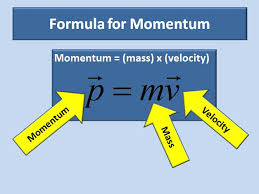
And no matter what happens, we say that "Momentum is Conserved" -- which means the force that object has comes from...somewhere, and goes... somewhere, but never is it lost or destroyed. I think Bill Nye says it best...
Students currently learning beginning algebra (7th+) and youngers if you want, print out this worksheet Momentum worksheet - - I will post answers later today when I can get my scanner working. ...And here they are=> MOMENTUM answers
Last but not least, review all three sections of chapter 3 and fill in the worksheet from class, both sides. And here is the answer key: chapter 3 review answers
And no matter what happens, we say that "Momentum is Conserved" -- which means the force that object has comes from...somewhere, and goes... somewhere, but never is it lost or destroyed. I think Bill Nye says it best...
Students currently learning beginning algebra (7th+) and youngers if you want, print out this worksheet Momentum worksheet - - I will post answers later today when I can get my scanner working. ...And here they are=> MOMENTUM answers
Last but not least, review all three sections of chapter 3 and fill in the worksheet from class, both sides. And here is the answer key: chapter 3 review answers
Monday, December 2, 2013
More on those 3 Laws...
Watch these lecture videos on Newton's 3rd Law:
Newton's 3rd Law- Derek Owens -- Watch the 4 sections Chapter 2.7 a-d
Read textbook pages 83-85 and answer the multiple choice questions on this 3 laws worksheet: http://www.jbgrimes.myclassupdates.com/sitebuildercontent/sitebuilderfiles/newtonsthirdlawws.pdf
Also, finish the 2nd page of the worksheet from class.
Now that you are really smart, here is some rocket science--
Friday, November 22, 2013
Homework:
Review Chapter 3, the beginning which you read last homework period (pages 75-79) and continue to the end of section 3.2 - reading carefully the parts "Projectile Motion" and "Centripetal Force". Do the "Try at home mini-lab on page 81. In your lab notebook, describe the experiment and answer the 3 Analysis questions.
Answer the Section 2 assessment questions, as well as the reading guide questions (handout from class).
And here are some fascinating videos to go along with our studies of motion:
What is a force?
What forces are acting on you?
Review Chapter 3, the beginning which you read last homework period (pages 75-79) and continue to the end of section 3.2 - reading carefully the parts "Projectile Motion" and "Centripetal Force". Do the "Try at home mini-lab on page 81. In your lab notebook, describe the experiment and answer the 3 Analysis questions.
Answer the Section 2 assessment questions, as well as the reading guide questions (handout from class).
And here are some fascinating videos to go along with our studies of motion:
What is a force?
misconceptions about falling objects
Why are astronauts "weightless?"
Why are astronauts "weightless?"
Tuesday, November 19, 2013
continuing with MT science...
Now that your ideas about how to build a mousetrap car are becoming clearer, RE-read the handout on the Physics of Mousetrap Cars. Write more notes at the bottom of the page, saying how you can build your car better for speed, distance and so on.
If you did not turn in the F=ma page, do it now. Link is in the previous post. If you did not watch those videos, please do so. There were too many blank faces on Monday. I'm hoping for some light bulbs. >>> ANSWER THIS QUESTION IN THE COMMENTS BELOW: In your own words and as succinctly as possible, what does "F=ma" mean?

If you did not turn in the F=ma page, do it now. Link is in the previous post. If you did not watch those videos, please do so. There were too many blank faces on Monday. I'm hoping for some light bulbs. >>> ANSWER THIS QUESTION IN THE COMMENTS BELOW: In your own words and as succinctly as possible, what does "F=ma" mean?

A Question to Ponder: What does gravity have to do with F=ma? We will explore this question on Thursday, and will work on our MTcars when we get back to the big room at the church. Read your textbook Chapter 3.section 2, but only pages 75-78, Gravity.
and two more short Eureka videos, AFTER you read the textbook! >>>Sunday, November 10, 2013
Force, Mass and Acceleration...it's a Relationship xoxox
Here is the homework which I inadvertently neglected to publish last Monday, so we will do it now. My goal for you is that you understand this Second law so well that you will incorporate it into your mousetrap designs. We will continue designing and building on Monday in class. I will require you to have a written plan before you cut wood, including measurements, seen by me.
******************************************************************************
Thanks for class today; hope you enjoyed the art lesson. Keep working on your designs, add measurements (how long are the side rails, how long the bed, what is the radius of the front/back wheels) and make it as accurate as possible. Keep thinking about how to reduce mass and friction. I will need to approve your plans before you cut.
Derek Owens, Video Tutor: This is particulary important for the 7-9th grade students to watch, in order to understand Newton's second law at your grade level, including how to use it in an equation. It is very good teaching, but unlike Bill Nye, it is neither funny, cute or annoying. Probably much to your relief. Watch the 2.3 segments numbered 2.3a-2.3f It takes about 30 minutes total in 6 segments, so break it up if you need to, and TAKE NOTES--pencils are the best brain-makers. Younger students: this may or may not be difficult, but try anyway, and let me know how it goes>>>I want to test your limits!
You should already have read in your textbook Chapter 3, section one, which discusses friction as well as Newton's 2nd Law. Read it again for review, and it should make lots of sense by now.
Lastly, some experimental stuff from TOPS to do at home -- find the "cards" 17, 18 and 19, cut out and glue in your lab books as discussed in class. Build An Accelorometer (card 17) Acceleration Is Change (18) and if you have time and like puzzles, try Seconds Per Second (19), which is very challenging but optional. Cards 17& 18 require a small jar; doesn't have to be a baby food jar--any glass jar with lid should work fine. Keep the accelerometer for a while and get to know it. :) Like I said >>> F=ma, it's a relationship.
******************************************************************************
Thanks for class today; hope you enjoyed the art lesson. Keep working on your designs, add measurements (how long are the side rails, how long the bed, what is the radius of the front/back wheels) and make it as accurate as possible. Keep thinking about how to reduce mass and friction. I will need to approve your plans before you cut.
Derek Owens, Video Tutor: This is particulary important for the 7-9th grade students to watch, in order to understand Newton's second law at your grade level, including how to use it in an equation. It is very good teaching, but unlike Bill Nye, it is neither funny, cute or annoying. Probably much to your relief. Watch the 2.3 segments numbered 2.3a-2.3f It takes about 30 minutes total in 6 segments, so break it up if you need to, and TAKE NOTES--pencils are the best brain-makers. Younger students: this may or may not be difficult, but try anyway, and let me know how it goes>>>I want to test your limits!
Go here for the chapter 2 playlist, but be sure to watch only sections 2.3a through 2.3f:
or else try here and watch continuously till you've finished all the way till 2.3f:
I handed out a F=ma worksheet in class for you to solve the problems. Ask your parents or siblings for help if you need it. Turn in on Thursday!!! Using a calculator is fine, but follow my directions, and SHOW YOUR WORK. - -Write the formula you will use -- plug in the numbers with the units -- solve -- draw a diagram like Mr. Owens did in the videos. The first problem is done as a demonstration of what I am looking for. Here is a copy if you've already lost the one from class: http://www.nhvweb.net/NHhs/Science/gcollins/CP%20Physics%20Assignments/Newton's%20Laws/F=ma%20Worksheet%20A.pdf
You should already have read in your textbook Chapter 3, section one, which discusses friction as well as Newton's 2nd Law. Read it again for review, and it should make lots of sense by now.
Thursday, November 7, 2013
MT Monday!
Important! We will start on our Mousetrap cars on Monday, and unlike yesterday, we will not hurry through it (yay!) So collect CD's with your mom's permission; if you are like my family there are probably a few around the house that are not important from years ago when we bought "educational" things that no one wants anymore. Recycle some toy wheels, bring in something lightweight to build with or just to try out...use your creativity. I will have most of the basics, but feel free to add to the collection.
Homework: Give some thought to the explorations in yesterday's class (re-read the cards carefully) , and answer any questions you might have missed in your lab notebook.
2. Finish reading the Mousetrap handout: write notes in the empty space at the bottom of the pages to comment on how to make your car go - faster - further - decrease friction - increase traction - reduce air resistance - decrease mass - and whatever to make it the best it can be! I suggest that you might pay better attention to what you read if you read it aloud; it works for me when I have to read things that are complicated.
When we finish building we will take them to the park for some races. (Hopefully the tennis courts will be available.)
3. Here is some great old-time science, from Julius Sumner Miller, a review on Inertia which I think you will enjoy, in 2 parts. 15 minutes. He cracks me up.
P.S. Does anyone have a broken laser pointer they would like to give me?
Homework: Give some thought to the explorations in yesterday's class (re-read the cards carefully) , and answer any questions you might have missed in your lab notebook.
2. Finish reading the Mousetrap handout: write notes in the empty space at the bottom of the pages to comment on how to make your car go - faster - further - decrease friction - increase traction - reduce air resistance - decrease mass - and whatever to make it the best it can be! I suggest that you might pay better attention to what you read if you read it aloud; it works for me when I have to read things that are complicated.
When we finish building we will take them to the park for some races. (Hopefully the tennis courts will be available.)
P.S. Does anyone have a broken laser pointer they would like to give me?
Monday, November 4, 2013
The topic of our text today is F.R.I.C.T.I.O.N --
___
Remember with a pencil - take notes!
And if you are not too sophisticated, Bill can't be beat for crazy science explanations. Still good to take notes. Watch until it gets truly annoying, which is after 10 minutes or so. But you can watch it all if you want.
For reading you have the mousetrap car basics which was handed out in class; remember to take notes on the blank portion at the bottom of each page, listing science vocabulary and ideas for making your MT car faster, stronger, better for distance, reducing friction, increasing traction, and so on. Read about half of the handout. AND THENNN...
Read the textbook, Chapter 3, section 1.
Thursday, October 31, 2013
Mighty Mousetraps
Thank you for your kind words and prayers for my husband who is in the hospital today and for the next day or two. He is getting better. I hope you had great fun at the Harvest party, and in celebration, just a wee bit of homework to prepare for science next week. Do a Google-image search to find pictures of cool mousetrap cars which you might emulate when we start building them in the next few weeks. Copy and paste them onto a document and print it out--try to find 4 good pictures of different models.
Here are a couple of youtube videos of mousetrap cars in action:
Also, begin collecting parts for wheels; old CDs or toy wheels or a large vinyl record, plastic lids or ??? Whatever you have, share the extra, and experiment. >>>If you have balsa wood or other lightweight wood or other items to experiment with, bring it in too.
Here are a couple of youtube videos of mousetrap cars in action:
And of course there are lots of youtube videos of what others have built and raced. If you find a great one, share in the comments below.
Monday, October 28, 2013
In Honor of Danny C...who has just been skydiving...
Just because it's cool...and interesting...and even educational...
TUESDAY - Study for the test by reviewing
vocabulary, re-reading the blog posts and re-watching the videos, re-read the textbook chapter 2, sections 1-3, and answering the end-of-chapter assessment.
WEDNESDAY - After a very brief review (10 minutes to look over the chapter and notes) put away your books and open the test handed out in class. Have your mom sign it after it is completed to attest that you did not look up answers in your textbook. Thanks! TURN IN ON THURSDAY!
Thursday, October 24, 2013
Need a Push?
Thanks for a great class--I'm sure you'll enjoy these videos:


Take notes: Remembering begins with a pencil.
Take notes: Remembering begins with a pencil.
Take notes: Remembering begins with a pencil.
Take notes: Remembering begins with a pencil.
Finally, READ your TEXTBOOK-- chapter 3, section 3 -- + study questions ---There will be a test next Thursday on this chapter. (woo-hoo! I love tests!)
Tuesday, October 22, 2013
Accelerated Learning3
Textbook Reading: Chapter 2, section 2 - Acceleration + end of section questions
worksheet: Speed-Time Graphs
Finish math worksheet started in class
Thank you for your kind attention in class, and for tracking with me through the math. I hope you enjoyed the puzzle of the pendulum - and finding patterns in the natural world. Square numbers are not just for math books; they are hidden in nature, along with many other treasures of wisdom and knowledge.
"By wisdom the LORD laid the earth's foundations, by understanding he set the heavens in place; by His knowledge the deeps were divided ...." Proverbs 3
Friday, October 18, 2013
Moving On --Meaning Motion
First thing first, add a description to you lab notebook of our final one-second pendulum group experiment. -- We did a bunch of 10-second trials, each person adjusting the length of their pendulum to make it run faster or slower, until we found the spot where it swung with a one-second period, that length turned out to be 25 cm, or so? And then we quickly experimented to find a two-second pendulum, which was about 100 cm. Can anyone make a guess as to how long would be a 3-second pendulum? Leave a comment below.
For homework, read Chapter 2, section 1 in your textbook.
In your lab books, make a page for Energy and Motion Vocabulary, and find the meaning of these words as you read: [along with definitions, draw a little picture to illustrate the concepts]
For homework, read Chapter 2, section 1 in your textbook.
In your lab books, make a page for Energy and Motion Vocabulary, and find the meaning of these words as you read: [along with definitions, draw a little picture to illustrate the concepts]
- distance
- displacement
- speed
- average speed
- instantaneous speed
- velocity
- what is the difference between distance and displacement
- what is the difference between speed and velocity
- what is the mathematical formula for finding speed?
And if you don't mind hyper-corny...
Monday, October 14, 2013
The Question Is Hanging...
...like a pendulum bob in the air, back and forth, back and forth. Is is the mass of the bob? Is it the length of the string? We are left to wonder...
But for now, no homework, except to write up your lab very simply, one sentence descriptions:
Purpose: To build a one-second pendulum
Question: What makes the period of the pendulum move faster or slower?
Hypothesis:
Data Table:
Conclusion: Does the data support or disprove your hypothesis?
Now what is your new hypothesis?
This was a great experiment for showing the value of controls- those things that stay the same, and the single variable which you change. Even though we have not finished...
And I'll See You On Wednesday afternoon, at the Exploratorium!!! ...where we will spend some quality time...with More Pendulums!!! You may bring your pocket-size cameras; it is a great way to take pictures AND notes! Also, I will give tickets for Store! Maybe a treasure hunt!
Wow!
But for now, no homework, except to write up your lab very simply, one sentence descriptions:
Purpose: To build a one-second pendulum
Question: What makes the period of the pendulum move faster or slower?
Hypothesis:
Data Table:
Conclusion: Does the data support or disprove your hypothesis?
Now what is your new hypothesis?
This was a great experiment for showing the value of controls- those things that stay the same, and the single variable which you change. Even though we have not finished...
And I'll See You On Wednesday afternoon, at the Exploratorium!!! ...where we will spend some quality time...with More Pendulums!!! You may bring your pocket-size cameras; it is a great way to take pictures AND notes! Also, I will give tickets for Store! Maybe a treasure hunt!
Wow!
Thursday, October 10, 2013
What can you do with a piece of string and a bob?
...besides fishing??
Now on to the next subject. Homework is to make a pendulum, any size you want, and observe, observe, observe. Write down your observations and the questions that come to mind as you ponder. I expect you to spend 45 minutes and write about 2 pages of notes(legibly) .
Write down:
What do you see, and what mystifies you...
What questions, what hypotheses, what possible experiments, what variables and what control...
What use is there, you will probably ask...
What deep truths to be unlocked???
No research in books or net, just hands and eyes, body and brain. You may also use measuring tools, like a tape measure or meter stick, and remember time can be measured too. An ipod or itouch or smarty-pants phone, even a watch with a second hand or stopwatch will work. Experiment=Experience.
Please bring those ipad/itouch/smartphone or stopwatches on Monday to class.
Extra Fun : If you have a little brother and sister, take them to the park, and swing. Especially if they are named Bob. Think about it.

Now reread the directions to make sure you have done all I asked.
But first, do the assessment questions 1-5 below the gizmos Density Lab, and also questions 1-3 on the gizmo page, Archimedes Principle (it's right below the gizmo; scroll down.) Check your answers by clicking "check your answers" at the bottom of the page. Print out to turn in. call me if you don't understand. 892-8540
 |
| How much water do those 3-men-in-a-tub actually displace? |
Now on to the next subject. Homework is to make a pendulum, any size you want, and observe, observe, observe. Write down your observations and the questions that come to mind as you ponder. I expect you to spend 45 minutes and write about 2 pages of notes(legibly) .
A pendulum is simply a weight hanging from a string attached to a fixed point, like the edge of a table, and which is free to swing back and forth.

Write down:
What do you see, and what mystifies you...
What questions, what hypotheses, what possible experiments, what variables and what control...
What use is there, you will probably ask...
What deep truths to be unlocked???
No research in books or net, just hands and eyes, body and brain. You may also use measuring tools, like a tape measure or meter stick, and remember time can be measured too. An ipod or itouch or smarty-pants phone, even a watch with a second hand or stopwatch will work. Experiment=Experience.
Please bring those ipad/itouch/smartphone or stopwatches on Monday to class.
Extra Fun : If you have a little brother and sister, take them to the park, and swing. Especially if they are named Bob. Think about it.
Now reread the directions to make sure you have done all I asked.
Monday, October 7, 2013
Homework for Thursday.
Start by remembering Monday's lab and putting your lab notebook in order. Describe the goal (make an object that will float with the most number of dimes inside) and summarize what you learned. Write up your results. Describe your most successful boat design. Think about how you might "quantify" your boat designs. >>"...it was 2 cm tall, the flat bottom was rectangular, and covered 18 square cm...etc." for example. In retrospect, what kind of measurements should you have taken?
Gizmos: follow log on directions from previous blog. Print out the student exploration and the vocabulary page. Follow the directions for Archimedes' Principle:
(skip activity C).
http://www.explorelearning.com/index.cfm?method=cResource.dspDetail&ResourceID=603&ClassID=2407757+

AND/OR: Do another hands-on experiment, this time using aluminum foil and pennies in your sink.
Print out and follow the directions.
And yes, you may do both>>>I recommend it!
Gizmos: follow log on directions from previous blog. Print out the student exploration and the vocabulary page. Follow the directions for Archimedes' Principle:
(skip activity C).
http://www.explorelearning.com/index.cfm?method=cResource.dspDetail&ResourceID=603&ClassID=2407757+
AND/OR: Do another hands-on experiment, this time using aluminum foil and pennies in your sink.
Print out and follow the directions.
And yes, you may do both>>>I recommend it!
Thursday, October 3, 2013
Just Catchin' Up...
Nice work on the demonstrations; they were much enjoyed by the littler kids and the parents. Best way to learn is to help someone else learn.
Monday, September 30, 2013
Exploding Soap, Does It Get Any Better?
Thank you students, for some enlightening demonstrations today. (get it? haha. OK, whatever.) Looking forward to the rest on Thursday.
Now let's try some computer simulations, aka* Gizmos. Go to: explorelearning.com
In upper right corner, click "login"
At the login page, enter password - jimbridger and username - jb - click login button.
At class page, click Gizmos.
If the density gizmo loads, then proceed by following the directions on your handout. [If you did loose the handout, you can find it at "Lesson Info.] First, answer the pre-lab questions, then go to the warm-up, and also Activity A. Then take a break, next day do activities B and C.
If the gizmo does not load correctly, then choose ?Support from the menu bar. Select Troubleshooting
. Then select ExploreLearning Systems Test Page, and run the system test. You may need to install Shockwave Full Version, or enable JavaScript or enable cookies. (Terry, I made sure your computer would work on Thursday.) None of these things are difficult, and there is probably someone in your family that can help, although I wouldn't be surprised if some of you are the computer genius of the family.
You should check with your parents for permission to do this, and if they are reluctant then you may skip the homework.
One last problem, it may be that only one student can log in at a time (?) so try again later.
Lastly, go over your notes from class; add any details you can remember, especially the explanations of density.
*also known as
 |
| Katherine Floating in the Dead Sea |
In upper right corner, click "login"
At the login page, enter password - jimbridger and username - jb - click login button.
At class page, click Gizmos.
If the density gizmo loads, then proceed by following the directions on your handout. [If you did loose the handout, you can find it at "Lesson Info.] First, answer the pre-lab questions, then go to the warm-up, and also Activity A. Then take a break, next day do activities B and C.
If the gizmo does not load correctly, then choose ?Support from the menu bar. Select Troubleshooting
. Then select ExploreLearning Systems Test Page, and run the system test. You may need to install Shockwave Full Version, or enable JavaScript or enable cookies. (Terry, I made sure your computer would work on Thursday.) None of these things are difficult, and there is probably someone in your family that can help, although I wouldn't be surprised if some of you are the computer genius of the family.
You should check with your parents for permission to do this, and if they are reluctant then you may skip the homework.
One last problem, it may be that only one student can log in at a time (?) so try again later.
Lastly, go over your notes from class; add any details you can remember, especially the explanations of density.
*also known as
Thursday, September 26, 2013
Sink or Float?
Thanks for class today, friends-- good concentration and good cooperation. Take a few minutes to clean up and re-write your lab report, according to the outline given. It doesn't need to be many words, but it is crucial that you be able to put into words the discoveries that you made. That way you can keep them and build upon them. What is the Big Idea that you come away with?
Then take a look at your personal density experiment, which you will present on next Thursday to the whole class. Get your supplies and try it out with your little brother or your dad. Be prepared to demonstrate and explain in about 3-4 minutes. Contact me if you have questions or needs. THINKING ABOUT THIS: Could about 6-8 of you students prepare to do your experiment on Monday? Comment below if you can--I would appreciate you volunteering. Class is too short for everyone to do theirs on Thursday. THANKS!
Lastly, a BrainPop. http://www.brainpop.com/science/motionsforcesandtime/buoyancy/preview.weml
You will need to log in with username pcshome and passwork ilearnathome
Watch the movie, take the quiz and read all the FYI pages (click the circles at the top)

Watch the movie, take the quiz and read all the FYI pages (click the circles at the top)
Monday, September 23, 2013
So which is heavier? A pound of feathers or a pound of lead?
What a crazy class today! But I hope you can be comfortable with the temporary confusion--it will lead to understanding and order very soon, probably. I had some technical difficulties with my computer equipment, which didn't help, and I am recovering from my son's wedding. But also, this is a subject that is best learned through testing and trial and hands-on experience. Keep your head in the game, focus on the subject, and really, really, really listen to instructions. If I say make a data table, then make a data table before you do the lab work, so you can record as you go. Most of you should make bigger tables with more room to write in.
Mass - how much stuff
Volume - how much space the stuff takes up
Density - how much stuff is in how much space
Is is tightly packed together? Is it fluffy like a pillow? These are questions of density.
Here are some videos to enlighten us:
Density Worksheet: Print out and complete http://ms.lindenwold.k12.nj.us/ourpages/auto/2011/10/18/45786733/Density%20calculations%20homework.pdf
If you have not yet turned in your Blowgun Lab Report, work on that now according to the Lab Report Guidelines that I handed out. (not just a page ripped out of your lab book)
Mass - how much stuff
Volume - how much space the stuff takes up
Density - how much stuff is in how much space
Is is tightly packed together? Is it fluffy like a pillow? These are questions of density.
Here are some videos to enlighten us:
Density Worksheet: Print out and complete http://ms.lindenwold.k12.nj.us/ourpages/auto/2011/10/18/45786733/Density%20calculations%20homework.pdf
If you have not yet turned in your Blowgun Lab Report, work on that now according to the Lab Report Guidelines that I handed out. (not just a page ripped out of your lab book)
Thursday, September 19, 2013
Measurement Lab
Thanks for a good class today; I appreciated how well you stuck to the task. It was all a big hurry, so now is the time to gather your thoughts and pull out the "moral of the story" which is, how do we take accurate measures?
You must have accurate and honest weights and measures, so that you may live long in the land the LORD your God is giving you. Deuteronomy 25.15
Your scales and weights must be accurate. Your containers for measuring dry materials or liquids must be accurate. I am the LORD your God who brought you out of the land of Egypt. Leviticus 19:36

Then we proceeded to measure.
1. No Need to Count Your Pennies - You should have a full-page copy of this lab activity sheet; Table 1 should have been filled out in class -- number of coins, mass in grams, and thickness in millimeters. Homework is to complete the worksheet: Graphs 1 & 2 and the questions on the back.
2. Length, Width & Height - This half-page should be glued or taped in your lab books, and you should have measured in centimeters, but to the nearest millimeter, so your numbers should have one decimal place, like this --> 3.1 cm, 8.6 cm and so on. The volume is figured by multiplying each dimension (length x width x height) and the units for that is cm3, (called cubic centimeters).
3. The Water Displacement Lab - Finding the volume of irregularly shaped objects, like rocks or my little yellow friend, Density Dan. Your pre-lab paper, which was how to find the water level on graduated cylinders, should have these answers:
1. 6 mL 2. 12 mL3. 1.6 mL4. 3.4 mLand also taped or glued into your lab books was the half-sheet "Water Displacement". To find the volume you had to find the difference (subtraction!) between starting and ending mL. Do you understand this?
Now, write in your lab books your revised definitions of mass and volume.
Take this further: Using only things you find in your kitchen, find the volume of your hand. (This is an exercise in problem solving -- don't ask your mom how to do it.) In your lab book, describe step-by-step how you did this.
So, how many of you still have all your papers from class and they are neatly glued in your lab books? Congratulations! Hopefully you can all read your own writing; some of you may consider putting a bit more effort into legible handwriting. Also, if you are rusty or unfamiliar with decimals, ask your mom to have you work on that in math. For now you should be able to add, subtract and multiply using decimals to the tenth's place. For math tutorials, try Khan Academy: https://www.khanacademy.org/math/arithmetic/decimals
Once again, practice vocabulary using Quizlet: http://quizlet.com/18339712/glencoe-physical-science-chapter-1-flash-cards/
Review the main ideas of this chapter with the Chapter Study Guide on Pages 32-35. Answer questions 1-10, 16, 18, 19
Monday, September 16, 2013
Homework for Thursday, September 19th
Thank you for a fine class; one of my goals, besides learning the scientific method, and having a fair amount of fun, is that you learn to work as a team with purpose and focus and cooperation. That takes a lot of practice, but I think you are going to be a great class. It was awesome that you were able to wrap up and clean up so quickly, and be ready for the next class, like soldiers at attention.
You have the handout from class, Lab Report Guidelines. Follow those instructions to make a rough draft of your first lab report. Bring that to class and we will talk about how to make it better. Typed is preferred; print out two copies, one for me and one to keep. Try your best, and expect to make it better as time goes on.
Reading from your Textbook: Finish section 2.2 on measurements, and read section 2.3 on graphing. Finish the pages from the textbook review handout.
How should you spend your time? I suggest an hour on Tuesday while the experiment is still fresh, to do as good as you can on the lab report, and then it might take about an hour on Wednesday to read and fill in the 3 remaining worksheets. I am interested in finding out how long these things really take, so make a note of it somewhere.

You have the handout from class, Lab Report Guidelines. Follow those instructions to make a rough draft of your first lab report. Bring that to class and we will talk about how to make it better. Typed is preferred; print out two copies, one for me and one to keep. Try your best, and expect to make it better as time goes on.
Reading from your Textbook: Finish section 2.2 on measurements, and read section 2.3 on graphing. Finish the pages from the textbook review handout.
How should you spend your time? I suggest an hour on Tuesday while the experiment is still fresh, to do as good as you can on the lab report, and then it might take about an hour on Wednesday to read and fill in the 3 remaining worksheets. I am interested in finding out how long these things really take, so make a note of it somewhere.
Thursday, September 12, 2013
Today's class was PG-13...
for Graphic scenes of science.
Chapter 1, section 1: The Methods of Science (textbook pages 6-13), and fill in the handouts from class pertaining to that section ( pages 19, 20, 27 ). There are 6 pages in the handout, but only do those three pages, which are not in order.)
Chapter 1, section 2, Standards of Measurement, read only pages 14-17.
Vocabulary!!! One great way to study vocabulary is by using Quizlet. All the words from chapter one are here: http://quizlet.com/18339712/glencoe-physical-science-chapter-1-flash-cards/ You can print out a vocabulary list or flash cards, you can test yourself online, or you can play games (I like Scatter best.)

When we come back on Monday, we will continue our experiment with the blowguns.
Thank you for your good-natured participation in our graphing lesson.
Monday, September 9, 2013
Don't Blow It!!
OK, you can blow it in this experiment, and what better way to test a toy than to play with it? Still, I wanna a little learning for my pains, so let us think about what we are doing, and use the Scientific Method!

We will continue our investigations on Thursday.
For homework: 2 handouts from class.
Ask your moms for help and also to check your work. If you happen to have lost the handouts, here are the links:
Improving Observations by Measuring
Comparing Units of Distance
Do as much as you are able, but you don't have to finish it if you don't understand. We will practice making graphs in class.
FYI
And if you are interested in reading a summary of how candles/fire works, here is something you can read:
Build-A-Better Blowgun
Purpose: to build a blowgun that is ________________________
Hypothesis: If I [Independent variable goes here], then the marshmallow will shoot [Dependent variable goes here].
Materials list
-
-
-
Design Plans: draw out, with dimensions/measurements
Test: how will I test? How will I record the data?
What must I control?
How can I tell if one design is really better?
Conclusion:
We will continue our investigations on Thursday.
For homework: 2 handouts from class.
Ask your moms for help and also to check your work. If you happen to have lost the handouts, here are the links:
Improving Observations by Measuring
Comparing Units of Distance
Do as much as you are able, but you don't have to finish it if you don't understand. We will practice making graphs in class.
FYI
And if you are interested in reading a summary of how candles/fire works, here is something you can read:
Thursday, September 5, 2013
Stuff Matters
- Textbook Physical Science - These belong to you; you may write and highlight in your own books.
- spiral bound notes book- to take notes from class and from the videos and textbook homework. Please title and date each new entry.
- 3-ring binder for handouts (separate or part of your big binder)
- lab notebook, for experiments and demonstration labs.
The Scientific Method 30min [right-click on the colored words; it will take you directly to a new page.] Print out these files:
Note Taking Guide Questions Part 1 Questions Part 2
Pause the video when asked and follow the directions. Take notes, filling in the worksheets as you go. YOU WILL NEED A CANDLE AND MATCHES AND Please FOLLOW SAFETY PROTOCOLS.
If you need help, feel free to call on any day except Sunday. 415 892-8540 Computer or printer issues? tell me right away. ALSO, DOES ANYONE HAVE A PVC PIPE CUTTER? Ask your dads...Put it in your backpack right now and bring on Monday. And leave a comment.
Monday, August 26, 2013
Moms, this one's for you. Here's where I describe what Physical Science is going to look like, and the way I am organizing things
Turns out, my way has become pretty popular, educationally, these days. And there's a name for it: The Flipped Classroom. Here is a 60-second explanation:
Middle school physical science covers such topics as: Matter, Forces and motion, Energy, The atom and the periodic table, Chemical reactions, Electricity, Waves, sound and light. see also Science Framework for California Public Schools. grade 8 focuses on physical science.
What are some highlights?
building a rocket, building a mousetrap car, field trip to the Exploratorium, a chemistry magic show put on by the students, a science faire project, graphs! yes, I said graphs. But wait, there's more! there's always more.
Materials and Requirements:
Students will need to acquire Glencoe Physical Science 2002 edition (through Amazon.com-click here.) Buy used!! the sooner you buy the better the price.) and a bound composition/lab notebook, plus a regular binder for handouts and notes. Plus at some point I will collect a materials fee, probably about $35. Sometimes colored pencils are handy.
If you have some chemistry equipment you would like to donate to the class, please do!
Homework:
I will post the homework on this blog by the morning following class, and I expect students to put in at least an hour on Tuesdays, Wednesdays and Fridays. It could take more time than this, depending on the student.
Since much of the content will be given online, please take responsible measures to keep out objectionable sites, as is appropriate to your family.
Please let me know if their are any special circumstances regarding your child's needs from this course. I am happy to help and I appreciate good communication.
Sign up on left to get emails; AND LEAVE A COMMENT BELOW SO I KNOW YOU HAVE READ THIS. ;)
Turns out, my way has become pretty popular, educationally, these days. And there's a name for it: The Flipped Classroom. Here is a 60-second explanation:
Things We Will Be Doing:
In Class- Labs & demonstrations
- Model building
- Discussion: peer reviewing lab reports, a little bit of math, correcting misconceptions and focusing on the main ideas.
- Field trips
- Textbook reading, answering questions
- Watching online videos or reading library books
- Writing informal lab reports
- Preparing demonstrations to share with class
- Interesting Stuff
Middle school physical science covers such topics as: Matter, Forces and motion, Energy, The atom and the periodic table, Chemical reactions, Electricity, Waves, sound and light. see also Science Framework for California Public Schools. grade 8 focuses on physical science.
What are some highlights?
building a rocket, building a mousetrap car, field trip to the Exploratorium, a chemistry magic show put on by the students, a science faire project, graphs! yes, I said graphs. But wait, there's more! there's always more.
Materials and Requirements:
Students will need to acquire Glencoe Physical Science 2002 edition (through Amazon.com-click here.) Buy used!! the sooner you buy the better the price.) and a bound composition/lab notebook, plus a regular binder for handouts and notes. Plus at some point I will collect a materials fee, probably about $35. Sometimes colored pencils are handy.
If you have some chemistry equipment you would like to donate to the class, please do!
Homework:
I will post the homework on this blog by the morning following class, and I expect students to put in at least an hour on Tuesdays, Wednesdays and Fridays. It could take more time than this, depending on the student.
Since much of the content will be given online, please take responsible measures to keep out objectionable sites, as is appropriate to your family.
Please let me know if their are any special circumstances regarding your child's needs from this course. I am happy to help and I appreciate good communication.
Sign up on left to get emails; AND LEAVE A COMMENT BELOW SO I KNOW YOU HAVE READ THIS. ;)
Subscribe to:
Posts (Atom)